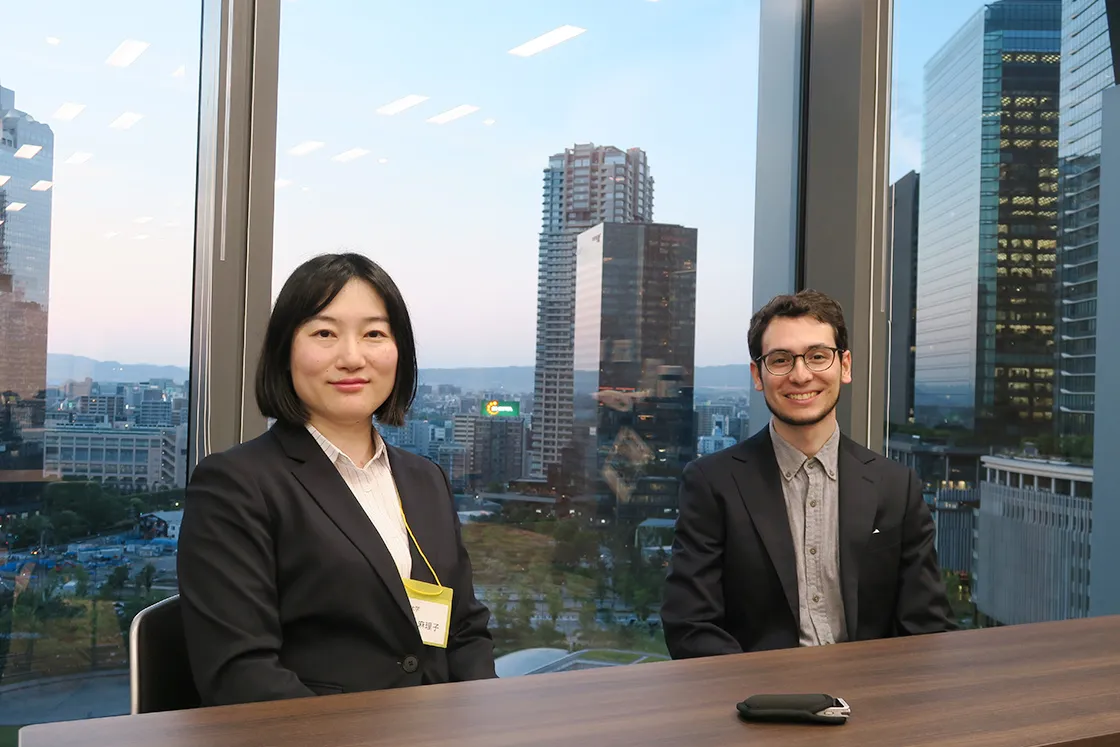
Japanese Fluency and Diversity
Dr. Ferreira da Rosa, Pedro Paulo
SUMITOMO CHEMICAL COMPANY, LIMITED
ICT & Mobility Solutions Research Laboratory
After coming to
Japan, he studied Japanese for one year at Osaka University
before entering Hokkaido University. He studied at Hokkaido
University from the undergraduate level through the doctoral
program.
While enrolled, he participated in Hokkaido University’s
networking events between doctoral talent and companies,
“Akai Ito-kai” and “CAREER LINK MEETUP” — the English
version of Akai Ito-kai. Completed the doctoral program in
the Division of Chemical Sciences and Engineering, Graduate
School of Chemical Sciences and Engineering, Hokkaido
University, in academic year 2021.
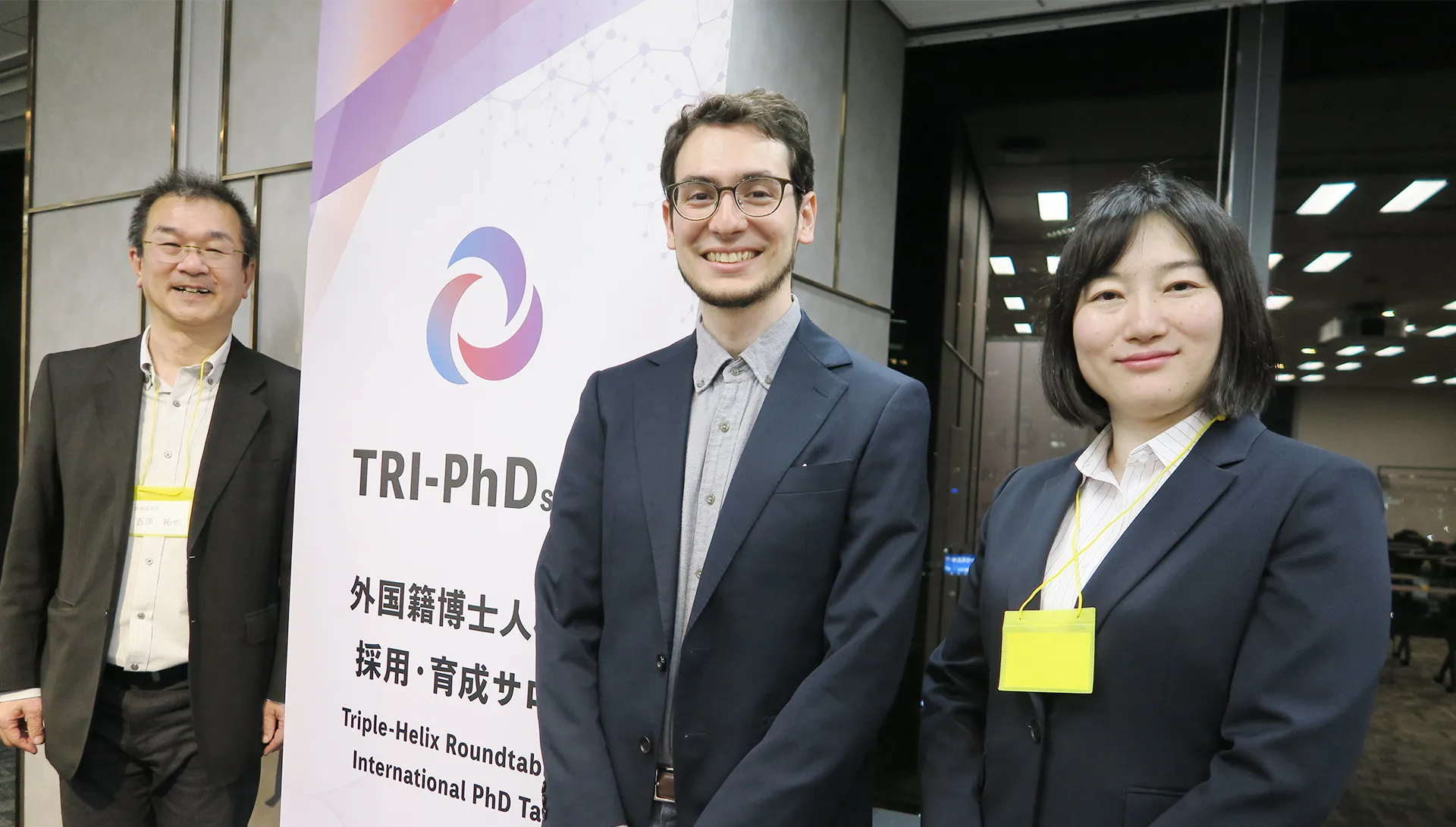
Mariko Katagaki(Interviewer)
Specially Appointed Assistant Professor, Doctoral Human Resource Development Unit, Center for Career Design, Institute for Academic Innovation, Hokkaido University
After working at private companies and as an administrative staff member at Hokkaido University, she assumed her current position in 2019. She is responsible for planning and implementing English-language programs to support graduate students’ career development. She also conducts research on the careers of international doctoral talent in Japan.
Dr.Takuya Yoshihara(Interviewer)
Director and Professor, Center for Career Design, Institute for Academic Innovation, Hokkaido University
After completing the master’s program in Nuclear Engineering at Hokkaido University, he joined NEC Fundamental Research Laboratories. There, he was involved in research on next-generation semiconductor manufacturing equipment and in planning intellectual property strategies. Since 2015, he has been engaged at Hokkaido University in the development of doctoral talent and in coordinating the Consortium for Doctoral Human Resource Development. While working at NEC, he earned a Doctor of Engineering degree from the School of Engineering Science, Osaka University.
Japanese Language and Career Development
Ferreira-san, even while you were still a student, your Japanese level was extremely high. You participated in Akai Ito-kai and conducted your job search in much the same way as Japanese students, didn’t you? What language do you use in your current work?

Reports for clients are sometimes written in English, but all internal documents, procedures, and discussions are in Japanese.
From the perspective of enabling international doctoral talent to thrive in Japan, there is often a debate about whether Japanese companies should become more English-friendly or whether international students should learn Japanese. What are your thoughts on this?
This is my personal opinion, but I believe that “foreigners should study Japanese.” The deeper a discussion becomes, the more it ultimately shifts into the language of that country. I think the same applies to research: if you are using a language you are not comfortable with, it becomes difficult to have deep discussions, and that can make it harder to achieve results.
When you speak fluent Japanese, do you feel that the other person’s reaction changes?
Yes. Japanese people are very kind to foreigners who try to understand the Japanese language and Japanese culture, and they place trust in them. The moment they realize that I can speak Japanese, their expression changes as if to say, “Oh, he can speak Japanese. That’s a relief.” (laughs)

Being trusted is a major advantage when working, isn’t it?
It makes things much easier. People remember my face more easily, and my supervisors and the people above them quickly came to recognize me.
You yourself began studying Japanese after coming to Japan, correct?
I was a MEXT scholarship student, so for the first year after coming to Japan, I was in an environment where I could focus on learning Japanese. In the mornings, I studied Japanese, and in the afternoons, I took subject classes, which were also conducted in Japanese. I even studied high-school-level mathematics and physics in Japanese.

Many international students come to Japan starting from graduate school. From the perspective of career development in Japan, how do you view that?
This is my personal opinion, but if possible, I think it is better to come to Japan as early as possible. Job hunting in Japan starts very early, so for example, if an international student comes to Japan in the first year of a master’s program and immediately has to start job hunting, that is almost impossible for them.
Even if universities provide information saying, “Job hunting in Japan starts early,” international students may not be able to fully understand what that means right away.
They cannot keep up with it. Even for me, until around my second year as an undergraduate student, I had no image of job hunting at all.
And they also need time to acquire Japanese language skills.
Exactly. That is why, in my personal view, programs that accept international students from the undergraduate level should be strengthened. Undergraduate students before laboratory assignment have relatively more time, so they can study Japanese, and by observing the Japanese students around them, they can naturally come to understand the system of job hunting in Japan.
From the university’s standpoint, we sometimes worry that if we tell international students too directly about the realities of job hunting in Japan, it may discourage them.
Of course, the way it is communicated is important, but I
think it is fine to be honest. Instead of simply saying, “You
will be fine with English,” it is important to also tell them
about the opportunities and career paths that open up when
they learn Japanese.
You can introduce successful examples together with the
message, “There are career paths like this.” I imagine that is
partly the purpose of this interview as well. If students can
see the goal, many of them should be able to persevere, even
if the path is difficult.
Working at a Japanese Company
What do you feel are the attractive aspects of working in Japan?
First, I think there is employment stability. Speaking from my
own company’s case, I often feel a sense of “persistence” as a
company, even in research. Of course, cost awareness is
necessary, but I feel there is an attitude of continuing
research with perseverance.
The reason I chose my current company was that it matched my
area of expertise, that it was a company actively engaged in
research, and that I was attracted to the fact that it
conducts research and development all the way through to
commercialization.
Japanese companies have a strong awareness of “protecting employment,” don’t they? Sometimes this is criticized as “not being the global standard.”
I think that, on the contrary, this is one of Japan’s major strengths and can be an appealing point.
How do you feel about concerns that jobs may disappear with the rise of AI?
Overseas, especially in science and engineering fields, I often hear discussions about introducing AI in order to reduce the number of employees. In Japan, however, I sense more of an intention to think about how to use AI in work while maintaining people.
The Balance Between Diversity and Japanese Fluency
In Japan, there is a tendency to expect international doctoral talent with different cultural backgrounds to be “different” in order to create innovation. However, the more quickly they learn Japanese and try to settle into Japanese society, the more their thinking may become “Japanese-like.” Do you feel that happens?
In my case, I have already become that way. (laughs) My boss even tells me that I “don’t seem like a foreigner.” I do not feel that people expect something from me just because I am a foreigner; rather, I feel that I am evaluated based on my skills as one developer.
In that case, focusing on Japanese language acquisition may actually dilute that “difference” and weaken the source of innovation. But that has nothing to do with an individual’s happiness, does it? Are you happy?
Yes, I am truly happy.
Language and culture are connected, and human beings adapt to
their environment, so I think it is natural that things become
blended. Perhaps that is a trade-off.

If that is the case, then perhaps to realize diversity, it would be better for Japanese people to go overseas, experience culture shock, and then return to Japan.
Yes, I think that would be more efficient. When Japanese people go abroad, some experience culture shock and change as a result. They also come to understand where foreigners struggle. I think it deepens their understanding of foreigners as well.
You mentioned that, at present, you would like to continue living in Japan. How did that feeling develop?
It is partly because I am used to Japan’s research environment and understand various processes here, and partly because of personal reasons. My wife, whom I met in Japan, is also a foreigner, but she is from a different country than I am. If either of us returns to our home country, it becomes a foreign country for the other person. So we discussed it together and decided that we would continue doing our best in Japan. We also like the environment here for children’s education and daily life.
Finally, could you give a message to junior international doctoral students?
By the time you reach the doctoral program, your
specialization becomes very sharp, but in companies,
“comprehensive ability” is required in addition to that. In
product development, you need to combine various materials and
work while engaging with multiple fields. Furthermore, it is
not enough simply to create something; you also have to think
about how to make it stable and reproducible.
In that sense, I think the ability to view things
comprehensively is important. I hope students will maintain
their own area of specialization as their core, while also
learning broadly. And they should prepare their Japanese as
early as possible. Once you overcome the language barrier,
there are many opportunities in Japan.