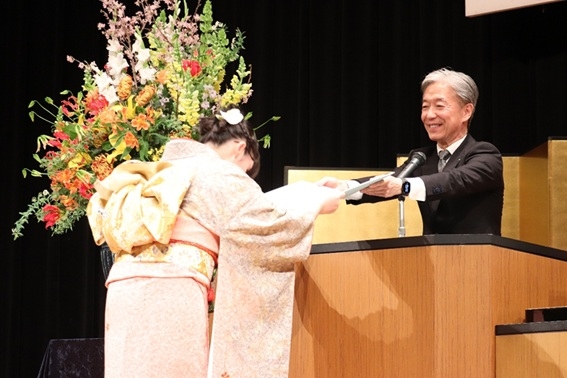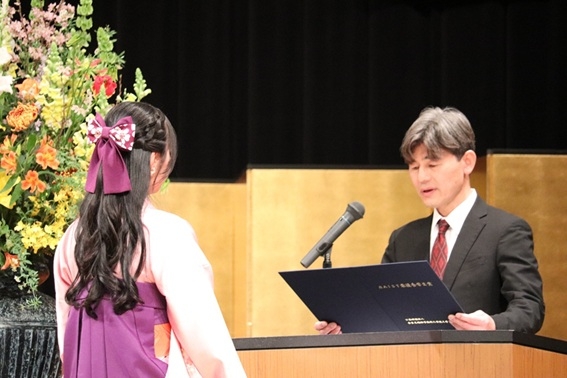
On Tuesday, March 24, 2026, a commencement was held in the Millennium Hall and 418 students received their diplomas.
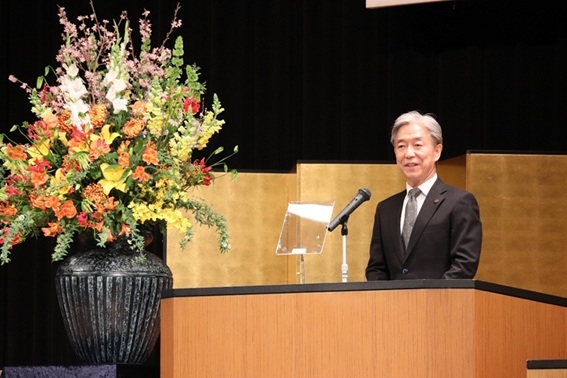
The commencement was held in two parts, one for the Master's course and the other for the Doctoral course. At the ceremony, President SHIOZAKI conferred diplomas to the representative of the Master's graduates and all the doctoral graduates, then gave a congratulatory speech to all graduates. Guests also made cerebrating speech to the graduates. After that, the representative of graduates replied the valedictorian speech. Then, NAIST Academic Excellence Awards were awarded to 14 selected students by Managing Director Masuda on behalf of the Foundation for NAIST.
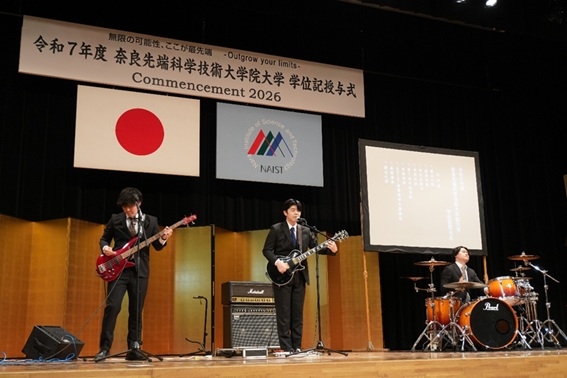
At the end of ceremony, congratulatory concert was held by volunteer students and celebrated graduates' departure. After the ceremony, the venue was open for commemorative pictures, where many graduates took memorial photos with their supervisors and juniors.
【Master's graduates】
Graduate School of Science and Technology 337(20 International students)
【Doctoral graduates】
Graduate School of Science and Technology 81(34 International students)
Total 418(54 International students)
【President's Commencement Address】
First and foremost, I would like to extend my heartfelt congratulations to all of you who have just been awarded degrees from NAIST. It is a great pleasure to be here with you to celebrate this memorable day in your life. I would also like to express my sincere gratitude to Mr. Tetsuya Kobayashi, President of the Foundation for NAIST, and Prof. Kiyoshi Kiyokawa, Chairperson of the NAIST Alumni Association, for their congratulatory addresses today.
I would also like to congratulate your families and friends, as well as the faculty members who have mentored you with passion and dedication. Today is also a special day for our Dean and Directors on stage, as well as for our faculty and staff who have supported your learning journey at NAIST in various ways. Please join me in offering a round of applause to everyone who has contributed to your graduate training, including those who could not be here today.
You are about to leave NAIST and embark on your respective paths in society, where you will strive to become true professionals in your chosen fields. When it comes to building our careers and shaping our lives, the one form of "capital" everyone possesses is time. An interesting study shows that how much of this capital we invest is more important than talent. The study was conducted by Anders Ericsson, who was a professor of psychology at Florida State University in the United States. He examined how much practice violinists and pianists undertake and found that reaching a top-level performance requires about 10,000 hours of cumulative practice. Notably, he found no "naturally gifted" music students or performers who reached the top level with significantly fewer than 10,000 hours of practice. Ericsson and his colleagues also examined the relationship between practice time and performance level among ballet dancers and found a similar figure of around 10,000 hours.
Similar results have been reported by other researchers studying chess players and athletes, leading to what is sometimes called the "10,000-hour rule" for achieving excellence. Since it takes about 10 years to accumulate 10,000 hours of serious training, we can assume that becoming a world-class expert in any field takes about a decade. In other words, what is necessary to become first-class is not talent, but sustained effort through time investment.
How about in the field of scientific research? I was originally trained as a yeast biologist, and in my field, Professor Yoshinori Ohsumi discovered the phenomenon called autophagy and later received the Nobel Prize in Physiology or Medicine. His major papers reporting the phenomenon were already published in the 1990s. Professor Ohsumi continued his studies and published more results. Yet it was not until the late 2000s, about 10 years later, that his work began attracting widespread attention, and citations of his papers increased rapidly. Similarly, Professor Shimon Sakaguchi, who received the Nobel Prize in Physiology or Medicine last year, published a paper in 1985 describing a type of cells that suppress immune responses. However, for some time, his work was not recognized by other researchers in the field. It was only about ten years later, in 1995, that regulatory T cells were acknowledged internationally.
As you can see in those examples, when we view a career over the long span of a lifetime, many suggest that the unit of progress is about 10 years or longer. From this perspective, the pursuit of short-term efficiency--often called "time efficiency"--may not be rational in the long run. Those of you who chose to pursue further studies at NAIST instead of entering the workforce immediately after graduating from a university or a technical college, as well as those who came to NAIST to earn a graduate degree after being employed, should take pride in your decision to pursue long-term rationality by opting for what might seem like "short-term irrationality".
Though I have said that it may take about ten years to become first-class in your field, that does not mean you should wait quietly for ten years to pass. In the well-known essay Tsurezuregusa, written in 14th-century Japan by Yoshida Kenkō, there is a passage that conveys the following idea:
"Those who think it is smart to practice a skill in private while they are still amateurs, only revealing it in public after they have become proficient, will never master it. On the other hand, those who place themselves among more skilled people, even when they are inexperienced and persist in their efforts despite criticism or ridicule, will steadily improve over time. They will eventually surpass those who rely solely on talent without practice, ultimately attaining true mastery and earning unparalleled recognition."
In other words, as Professor Ericsson's research suggested, what truly matters is not talent but persistent effort in one's chosen field. Kenkō also emphasizes the importance of not being afraid of embarrassment or failure along the way. Reflecting on my own experience as a researcher, I believe the same. By conducting clumsy experiments, writing imperfect papers, and giving awkward presentations--experiencing and learning from repeated embarrassment--after about ten years, one gradually becomes recognized as a respectable researcher. Whatever challenges you take on and whatever career path you choose from now on, it will take many years before you are recognized as a true professional in your field. During that time, you may experience major failures or embarrassing moments. Yet you should believe that, in the long run, it is the most rational path, and continue moving forward with confidence and determination.
Once again, my sincere congratulations to all of you. Even after graduation, you remain a member of the NAIST community. Our alumni association serves as a global network for graduates, so I encourage you to participate actively and stay connected with NAIST. NAIST is an institution on the move, and the NAIST diploma you received today will only increase in value and prestige over time. In turn, your future success and accomplishments as our graduates will enhance the university's value and reputation.
Let me close my commencement address with my parting wish for you all: May the next decade of your journey, beginning tomorrow, also bear great fruit!
Kaz Shiozaki
President