


Paving the Way for Research
to Benefit Society through
Startup Creation
KATO Hirokazu (Executive Director/Vice President)✕
SAWABE Taishi(Associate Professor,
Interactive Media Design Laboratory,
Division of Information of Science)
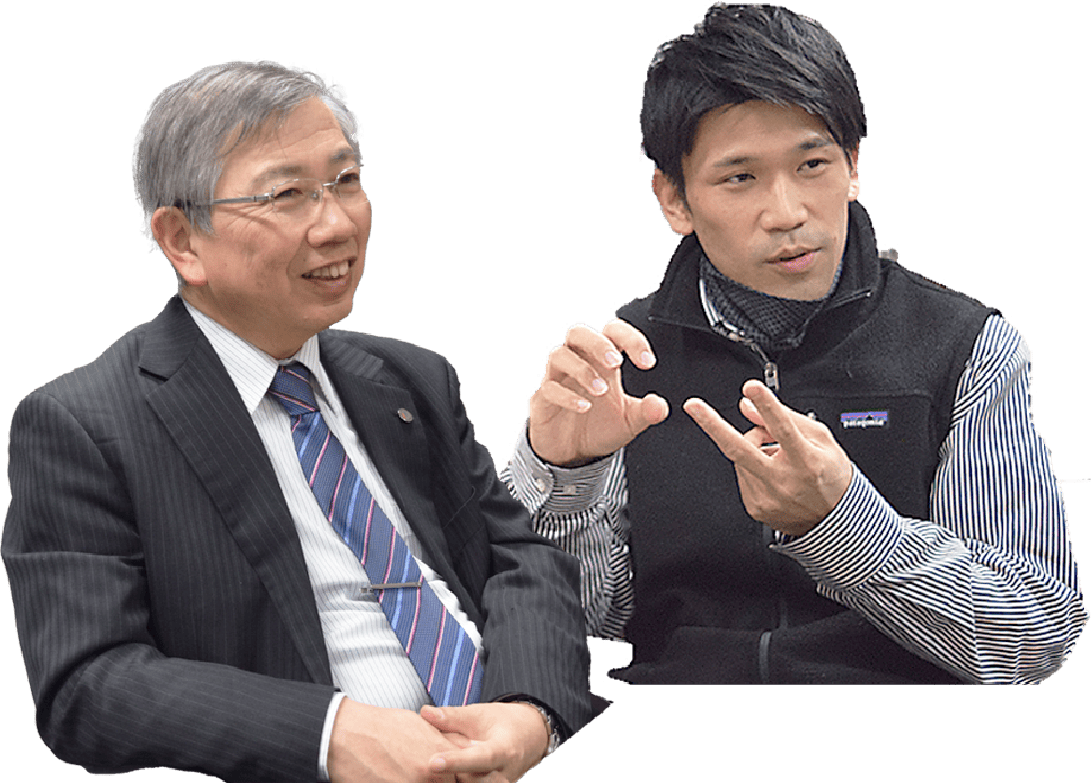
Paving the Way for Research
to Benefit Society through
Startup Creation
KATO Hirokazu (Executive Director/Vice President)✕
SAWABE Taishi(Associate Professor,
Interactive Media Design Laboratory,
Division of Information of Science)

The momentum is being built for the creation of university-based startups where researchers launch businesses based on outstanding university research results. The Nara Institute of Science and Technology (NAIST) has long offered programs aimed at developing individuals with an entrepreneurial spirit, and several university-based startups have already emerged.
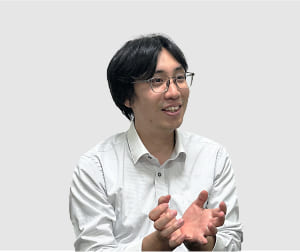
Accordingly, Prof. Hirokazu Kato, the executive director and vice president (and professor at the Interactive Media Design Laboratory, Division of Information Science), and Prof. Taishi Sawabe, an associate professor at the Interactive Media Design Laboratory, Division of Information Science, who serves as a faculty member at our university and runs amirobo tech Inc., the university-based startup in smartphone application development, discussed the current status and future of university-based startups by faculty members.
profile
KATO Hirokazu (Executive Director/Vice President)
Career
-
1988
Mar.
Master of Engineering, Graduate School of Engineering Science, Osaka University
-
1989
Apr.
Research Associate, Faculty of Engineering Science, Osaka University
-
1996
Jan.
Doctor of Engineering, Osaka University
-
Apr.
Lecturer, Graduate School of Engineering Science, Osaka University
-
1999
Apr.
Associate Professor, Faculty of Information Sciences, Hiroshima City University
-
2003
Apr.
Associate Professor, Graduate School of Engineering Science, Osaka University
-
2007
Apr.
Professor, Graduate School of Information Science, NAIST
-
2010
Apr.
Advisor to the President, NAIST
-
2013
Apr.
Vice Dean, Graduate School of Information Science, NAIST
-
2017
Apr.
Director, Information Initiative Center / Director, University Library, NAIST
-
2018
Apr.
Professor, Division of Information Science, Graduate School of Science and Technology, NAIST
-
2021
Apr.
Professor, Center for Digital Green-innovation, NAIST
Advisor to the President, NAIST -
2023
Apr.
Executive Director and Vice President, NAIST (Present)
SAWABE Taishi (Associate Professor)
Career
-
2016
Mar.
Master of Engineering, Graduate School of Information Science, NAIST
-
2019
Mar.
Doctor of Engineering, Graduate School of Information Science, NAIST
-
Apr.
Postdoctoral Fellow, Division of Information Science, Graduate School of Science and Technology, NAIST
-
2021
Apr.
Assistant Professor, Division of Information Science, Graduate School of Science and Technology, NAIST
-
2024
Nov.
Associate Professor, Division of Information Science, Graduate School of Science and Technology, NAIST
Hobbies
Watching movies, TV drama series, and anime;
playing with LEGO; and photography
On my days off, I relax by enjoying an unordinary world of watching movies and playing with my cat.
interview

Entrepreneurship Education Implemented for Ten Years
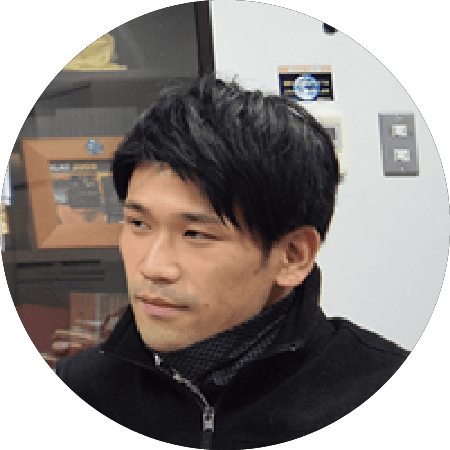
Prof. Kato
In 2015, NAIST launched the Global Entrepreneurs on the Internet of Things (GEIOT) program, which aimed to develop entrepreneurs and human resources focused on innovation. At that time, Japan fell behind the United States in the launch of university-based startups; we started the program through a grant from the Ministry of Education, Culture, Sports, Science and Technology to promote education that would inspire entrepreneurship. The program was designed for participants to meet every Saturday in Osaka City to allow students to focus on their research during the week and for visitors from outside the university to easily visit the venue. In many other universities, industry-academia collaboration departments were responsible for entrepreneurial education, while at our university, faculty members at the Division of Information Science took the lead in lecturing students at the Division of Information Science and invited executives from startup companies to teach students about their business plans. At the time, the concept of entrepreneurship had not been widely adopted on campus, and the instructors had not yet figured out how to provide such education. Currently, students from the Divisions of Biological Science and Materials Science are also taking part in the program, and it is a great success because we have twice as many applicants for Academic Year 2024 as when it began (30 applicants).
Prof. Sawabe
I’m a zero-generation student, since I attended the GEIOT program in the inaugural year when I was in the second year of the master’s program in the then Graduate School of Information Science of NAIST. When I was an undergraduate at Ritsumeikan University’s College of Science and Engineering, I took an entrepreneurship education course in the College of Business Administration. However, there were few lectures on commercializing new science and technology. I enrolled at NAIST and joined GEIOT because I thought I could continue my research and learn how to commercialize and implement the seeds of my research in society.

Having Identified Challenges in Commercialization
Prof. Kato
The goal of startups is not just to conduct research and author papers but to go further. Another key point is how to implement those research results in society and commercialize the results for profit. Entrepreneurial education is about developing the ability for students to see far into the future. It is certainly exciting for researchers to see the results of the technology they helped to develop. This may often be misunderstood; however, it does not mean that all researchers must start their own businesses. It is ideal if diverse researchers, including those who work on basic research, those who are focused on collaborative research with companies, and those who would start businesses, would advance university research.
Prof. Sawabe
After learning with the GEIOT program, I established amirobo tech Inc. during my doctoral course. While studying as a student, I was conducting research to examine the effectiveness of humanoid conversational robots installed to monitor elderly adults, but the cost of robots posed a barrier from the perspective of a practical solution. I then decided to conduct research using a smartphone application in which a character would interact with the user, which I was developing concurrently. However, this experiment had issues where the subject attributes were biased, and the number of participants was limited. Therefore, I decided to release the application to the public to collect dialogic data and to determine whether it was actually able to perform the monitoring. At that stage, I established a company to release the application, but one issue to address for the business going forward was the need of modification because there was a gap between the uses expected in the research phase and those who would actually pay to use the application. Another issue was the legal knowledge that ensures that the copyright royalties were reflected in the costs. Neither of those issues could be specified through technology research alone.

Can It Be Balanced with Research Activities?
Prof. Kato
The management of university-based startups takes a variety of forms. In Prof. Sawabe’s case, a researcher became president and has been involved in management. However, there is another way where the university researchers provide only the technology and leave company management to external experts. I think that the latter case is more likely to be successful for our university. However, finding human resources who fully understand the research results and who can work passionately on research at the pace of the research is tremendously difficult, You dare to enjoy both research and your role as president, don’t you?
Prof. Sawabe
Yes, I do. It is difficult to operate the research laboratory by myself, but I have a team of faculty members and students who share the load for its operation and management, which allows me to have a side job. Since NAIST is a graduate school, our research environment is set up, and we can receive comments from a business perspective through interactions with companies in the neighboring Keihanna area. We have a diverse student body that consists of graduates from other universities and technical colleges and international students, and the strengths of each student’s technical research sometimes provide hints to practical application. I also think that it is good that as a university the barriers to starting up are not high.
A startup is a small business that you start with very little funding, but as a researcher, it is rewarding to develop business with the important goal of solving social issues and growing on a global scale. However, even if a research paper is academically recognized, predictions and advice from management consultants may be required as to the extent of economic impact of that technology on general users. In addition, the start and end of the fiscal year are determined on the basis of the timing of starting up a business. I started my business in the winter, so amirobo tech’s fiscal year-end overlaps with the timing of the master’s thesis review, which makes time management and work difficult. That was a miscalculation.
* Note from the Secretariat: Prior approval is required when taking on concurrent positions as an executive officer. If you are considering this, please contact the Personnel Division in advance.

Doing Businesses in a Variety of Fields
Prof. Kato
With support from the University-based New Industry Creation Fund Project by the Japan Science and Technology Agency, four projects from NAIST were selected in academic year 2024 in the KSAC-GAP Fund program, where the Kansai Startup Academia Coalition (KSAC) provides funding for research and development projects at universities in the Kansai region. They include two from the Division of Information Science, one from the Division of Biological Science, and one from the Division of Material Science. Two among them are research in the healthcare field, such as healthcare management and fermented foods. The prevalence of startups in the healthcare field is a nationwide trend. Furthermore, deep tech, which has a close relationship with research in the Division of Material Science, is attracting a lot of attention as a university-based startup. I think that our university needs to strengthen the divisions that discover promising research seeds that will lead to startups. I hope that young faculty members will be aware of our university’s philosophy and goals and have big dreams beyond the results of their research.
See other interviews
-
Uncharted Research Fields
and Future Outlook
OYAMA Ryoko (Assistant Professor, Division of Materials Science)
-
Work-Life Balance
and Career Advancement
OHTSU Mina (Assistant Professor, Hokkaido University)
-
Work-Life Balance
Bermundo Juan Paolo Soria (Assistant Professor, Division of Materials Science)
-
Academic Experience
at Other Universities
KASHIWA Yutaro (Associate Professor, Division of Information of Science)
-
Career Advancement
YAMASAKI Shotaro (Associate Professor, The University of Osaka)
Recruitment Promotion Site
