


Developing next-generation
sustainable thin-film
transistor fabrication process
Bermundo Juan
Paolo Soria(Assistant Professor,
Information Device Science Laboratory,
Division of Materials Science)

Developing next-generation
sustainable thin-film
transistor fabrication process
Bermundo Juan
Paolo Soria(Assistant Professor,
Information Device Science Laboratory,
Division of Materials Science)

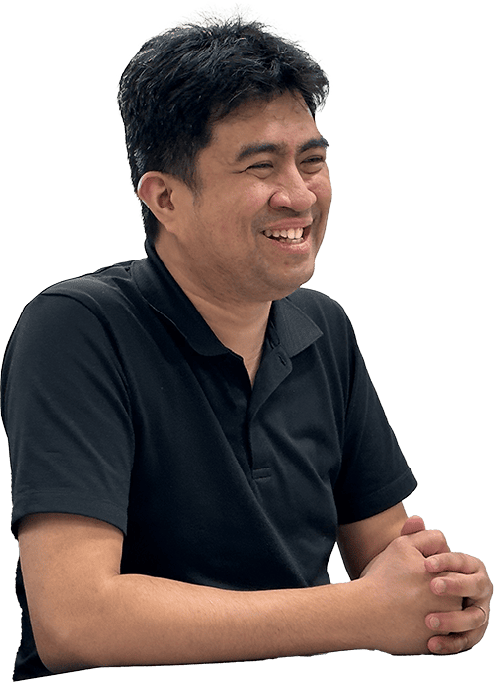
Assistant Professor Bermundo Juan Paolo Soria is engaged in research to improve the performance of oxide semiconductor thin-film transistors (TFTs), which are expected to be applied to next-generation sensors and displays such as flexible displays.
He is a graduate of Ateneo de Manila University in the Philippines and NAIST's doctoral course, and he encourages students in his home country to study in Japan, saying, “the research and education environment is excellent in NAIST.
profile

Bermundo Juan Paolo Soria
(Assistant Professor)
Career
-
2012
Mar.
Master of Science, Physics, Ateneo de Manila University
-
2015
Jun.
Doctor of Engineering, Graduate School of Materials Science, NAIST
-
Aug.
Assistant Professor, Graduate School of Materials Science, NAIST
-
2020
Oct.
Assistant Professor, Division of Materials Science, Graduate School of Science and Technology, NAIST
Hobbies
Computers, Technology, Basketball
In my free time, I read articles and watch videos about technology especially on computers, semiconductors, artificial intelligence, quantum computing, etc.. I also usually spend time with my family during weekends.
interview

What goals have you pursued in your research?
The Japanese government's “Society 5.0” vision of a future society envisions a human-centered society strongly connected to the digital space. However, the current fabrication process using vacuum is costly and poses environmental sustainability challenges such as material and energy waste. We have therefore taken on the challenge of developing a method to manufacture high-performance TFTs by conducting all processes in a low-temperature sustainable solution process to overcome these issues.
Tell us about your research findings.
In our previous research, we had discovered that instantaneous irradiation of TFTs with a laser (excimer laser) with a short wavelength in the ultraviolet region creates oxygen vacancies on the surface of the thin film, which increases the conductivity. Applying this phenomenon, we have succeeded in developing a method to create high performance and highly stable TFTs using low-temperature solutions process by selectively generating oxygen vacancies on the oxide semiconductor film through UV, laser, and plasma irradiation. We are now conducting research on making these TFTs more multifunctional.

What is your impression of NAIST's research environment?
I think it is great that the barriers between laboratories are low and we can consult with each other on a daily basis and collaborate closely. I myself am learning machine learning which is a different field from mine through meetings with the Data Science Center (where I am a member concurrently), which I intend to apply to my next research project. I have always been a firm believer in “making the most of interactions with people you meet“. One example is: I happened to be interested in a poster presentation of a German laser company at an international conference, and the discussion there led us to a joint research project. Subsequently, we had a fruitful result, such as the submission to another conference and publish in a journal.
NAIST has many state-of-the-art research facilities, and I appreciate that the technical staff in charge of these facilities explain them to me in great detail. I have not felt much of a language barrier in the laboratory or at the university, as everyone tries to communicate in English.

What led you from Ateneo de Manila University to NAIST's doctoral program?
As a graduate student in the Department of Physics at Ateneo de Manila University, I studied volume holographic data storage and volume holographic multiplexing. I also taught Physics and materials science to students as a lecturer in the Department of Physics. Around that time, I had the opportunity to visit NAIST for an internship, because Ateneo de Manila University and NAIST have an academic exchange agreement. I experienced the friendly atmosphere of the graduate school and decided to enroll.
I am also a member of the international public relations committee in the division of Materials Science, and when I visit universities in my home country for student recruitment and other purposes, I appeal to them that NAIST has the best research environment.

Your wife, Jennifer san, has graduated from NAIST too.
My wife and I met at Ateneo de Manila University and both came to Japan to enroll in the doctoral program at NAIST's Graduate School of Materials Science. She completed her doctoral studies in the Quantum Materials Science Laboratory (at that time), and after working at the National Institute of Advanced Industrial Science and Technology (AIST), she is now working for a Japanese private company in research and development. Japan is a safe and comfortable place to live, and NAIST has made great efforts to support child-raising, including the establishment of an on-campus childcare center. My elder daughter, who is entering an elementary school student in the spring 2025, speaks Japanese natively, even correcting my mistakes in Japanese.
Prof. Uraoka who is the head of our laboratory enthusiastically grows vegetables in the green lab on NAIST campus, and from time to time he holds a party where the staff and students are served the harvested vegetables. This kind of family-like care is found throughout NAIST, and I think this is another great advantage of NAIST.
 Please share a message
with young researchers.
My research motto/philosophy is “Staying curious while upholding scientific rigor and integrity”. I would like to continue to conduct research in Japan and at NAIST that can solve social problems.
As we move toward the next-generation society, semiconductors will play an increasingly vital role in shaping and enhancing our daily lives. I aspire to contribute to the sustainable advancement of semiconductor technologies through reducing waste and enabling low power operation, ensuring their continued impact in empowering and transforming our society. My message to young researchers: Stay curious and always aspire to do more, especially for the benefit of others and society. By embracing this mindset, they can cultivate a passion for disciplined excellence, striving for continuous improvement while remaining grounded in the impact of their work. May their efforts be driven by the desire to solve real-world problems and contribute meaningfully to society.
See other interviews
-
Uncharted Research Fields
and Future Outlook
OYAMA Ryoko (Assistant Professor, Division of Materials Science)
-
Work-Life Balance
and Career Advancement
OHTSU Mina (Assistant Professor, Hokkaido University)
-
Startup Creation
KATO Hirokazu (Executive Director/Vice President)
SAWABE Taishi (Associate Professor, Division of Information of Science) -
Academic Experience
at Other Universities
KASHIWA Yutaro (Associate Professor, Division of Information of Science)
-
Career Advancement
YAMASAKI Shotaro (Associate Professor, The University of Osaka)
Recruitment Promotion Site
