


Good Environment
for Research
OHTSU Mina(Assistant Professor, School of
Science, Hokkaido University,
Adjunct Assistant Professor)
Good Environment
for Research
OHTSU Mina(Assistant Professor, School of
Science, Hokkaido University,
Adjunct Assistant Professor)

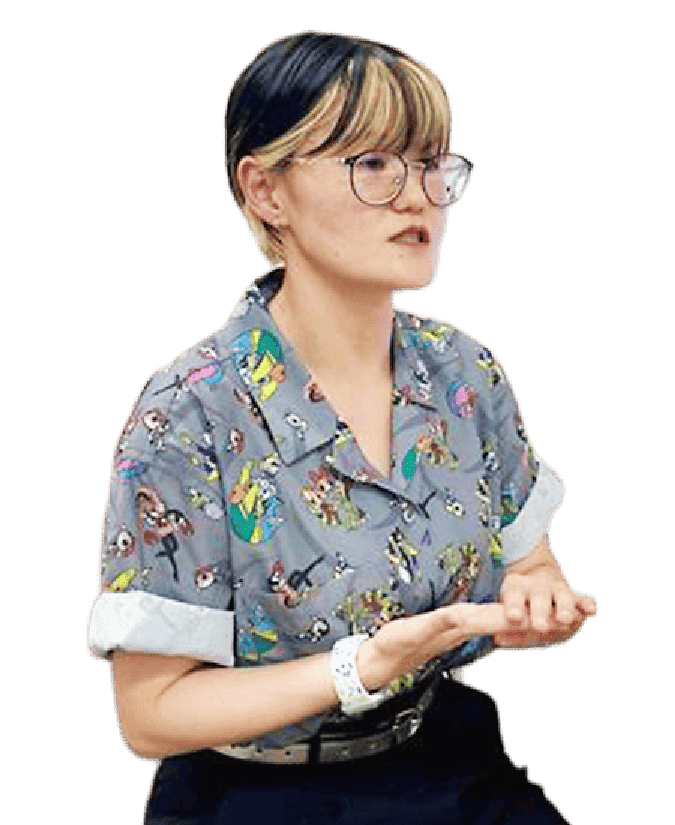
Assistant Professor Mina Ohtsu is researching plant-microbe interactions.
In particular, she focuses on the highly unique mode of cyst nematode infection that induces cell fusion in plants to form infected cells and strives to elucidate its mechanism of action.
She served as an assistant professor in the Department of Biological Science and is currently an adjunct assistant professor at NAIST.
In November 2025, she was appointed an assistant professor in the School of Science, Hokkaido University, by which she has paved the way to conduct her own research for many years.
profile

OHTSU Mina (Assistant Professor)
Career
-
2012
Mar.
Bachelor of Agriculture, School of Agricultural Sciences, Nagoya University
-
2014
Mar.
Master of Agriculture, Graduate School of Bioagricultural Sciences, Nagoya University
-
2015
Apr.
JSPS Research Fellow (DC2), Japan Society for the Promotion of Science (Nagoya University)
-
2017
Mar.
Doctor of Science, Graduate School of Science, Nagoya University
-
Jul.
Postdoctoral Researcher, John Innes Centre, United Kingdom
-
2019
Mar.
Overseas Research Fellow, Japan Society for the Promotion of Science (John Innes Centre)
-
2021
Jun.
Postdoctoral Researcher, Division of Bioscience, Graduate School of Science and Technology, NAIST
-
Jul.
Assistant Professor, Division of Bioscience, Graduate School of Science and Technology, NAIST
-
Oct.
PRESTO Researcher, Japan Science and Technology Agency (Concurrent position)
-
2025
Nov.
Assistant Professor, School of Science, Hokkaido University
Adjunct Assistant Professor, Division of Bioscience, Graduate School of Science and Technology, NAIST
Hobbies
Playing with my cats and visiting restaurants and cafes for delicious food
I’ve been living with cats for about two years. Since then, many things in my life have become cat centric. On weekends, I visit different cafes and restaurants to enjoy coffee and lunch.
interview
What research topic have you focused on?
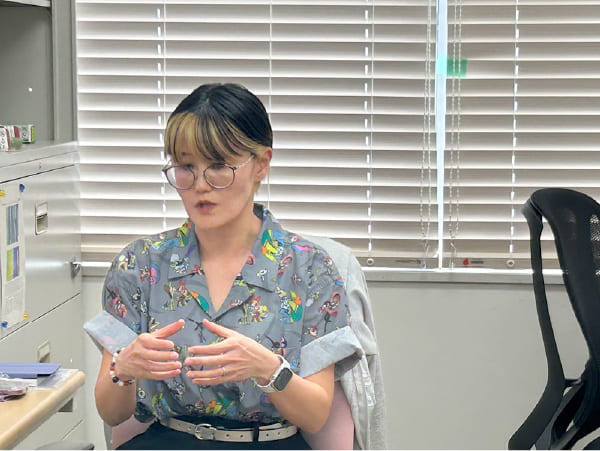
Plant-parasitic microorganisms parasitize plants by using a variety of strategies, including altering the morphology and properties of infected host plant cells. Cyst nematodes (hereinafter referred to as “nematodes”), a type of plant-parasitic nematode, fuse the plant cells together and create large infected cells in order to take in nutrients from the host plant. As a matter of fact, cell fusion is extremely rare in plant cells, and it has been observed only under the limited conditions of double fertilization and grafting. Therefore, I became deeply interested in the mechanisms of action where nematodes cause cell fusion in plants, and I continue my research to unravel that mystery.
How rare is the phenomenon that fuses plant cells during the infection process?
The fusion of plant cells is a quite rare phenomenon because the cells are surrounded by a sturdy cell wall on the outside, compared to animal cells, which lack cell walls and possess only a flexible membrane. As I mentioned earlier, cell fusion in plants has only been observed under the limited conditions of double fertilization and grafting, and the detailed mechanisms of action remain unraveled. The fact that nematodes, hundreds of times smaller than a plant, can intentionally induce such a phenomenon can be regarded as an extremely unique mode of infection. Even more than 50 years after the observation, many aspects remain unexplained, which has sparked my aspiration for research.
What outcomes have you achieved so far?
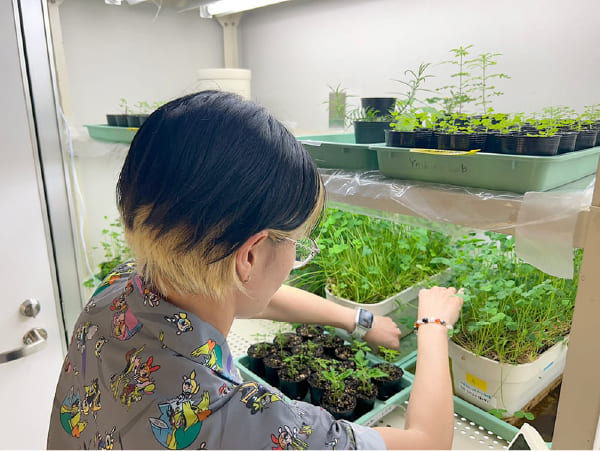
I think that while the mechanism underlying cell fusion remains unclear, the three-dimensional morphology of nematode-infected cells has provided clues to elucidate the formation of infected cells. Sample clearing techniques and the use of a two-photon excitation microscope have made it possible to observe infected cells. As a result, we found that the cell walls of infected cells remained in a regular, columnar pattern, spreading out in an orderly arrangement reminiscent of the colonnade of the Parthenon in Greece. It was thought that nematodes randomly degraded cell walls to cause cell fusion. However, from the results of this observation, we revealed for the first time that nematodes skillfully guide the degradation and synthesis of cell walls based on the regularity of existing cell walls to reconstruct the cell walls.
Furthermore, since infected cells form only in a small portion of the entire root and are produced deep within the root, it is extremely difficult to concentrate infected cells. Recently, a method for concentrating and collecting infected cells is also being established and was inspired by experimental results showing an increase in nuclear size and phase (the number of homologous chromosomes) in infected cells. This may make it possible to track in detail the changes in gene expression that occur as a result of cell fusion.
What is your attitude toward research?
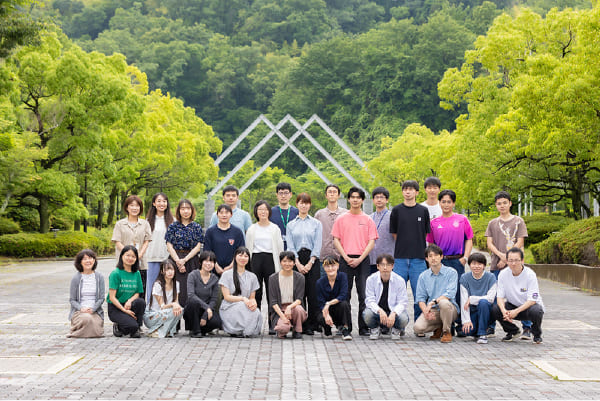
I would like to adhere to my distinctiveness without being influenced by trends in the research field as well as by challenging the work with a focus on research themes that truly interest me.
Please tell us about your path as a researcher up until now.
Since I started my research when I was a senior at university, I have consistently focused on plant-microbe interactions. I wanted to pursue research on plant-microbe interactions from a more basic scientific perspective in my doctoral studies. Therefore, I enrolled in the Graduate School of Science and changed my research department. The lab I enrolled in during my doctoral course allowed me to freely choose research topics, so I chose a completely different topic from my lab and began research on plant-nematode interactions. After completing the course, I researched the interaction between Arabidopsis thaliana, a model plant of the family Brassicaceae, and the Brassicaceae anthracnose fungus for four years as a postdoctoral scientist at the John Innes Centre in England. My research theme was to elucidate how the effectors, pathogenic molecules secreted by the anthracnose fungus, evade the host plant’s immune system to establish an infection.
Since I was appointed to the Nara Institute of Science and Technology in 2021, I then resumed my research on nematodes for which I established the system during my doctoral course.
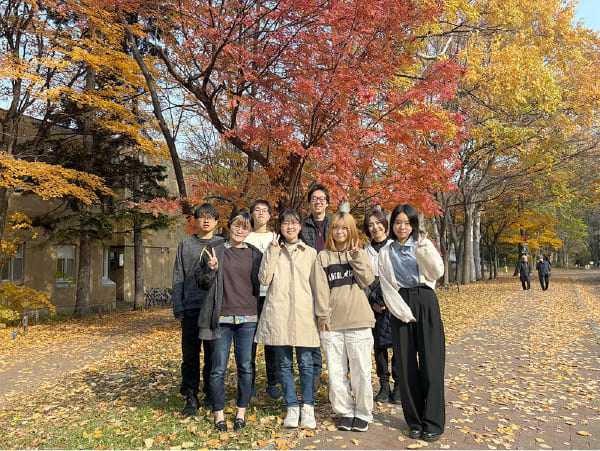
What do you think of the research and education environment at Nara Institute of Science and Technology (NAIST)?
I think that NAIST provides a great environment for focusing on research among Japanese universities. It is well-equipped with high-performance shared instruments, such as microscopes, which is required for my research, and the research facilities are excellent. I also think that at NAIST, we have less administrative work related to student education than at comprehensive universities. Assistant professors mainly teach short-term lecture classes and can appropriately allocate their time to research and education at their discretion. In addition, many young faculty members are of the same generation who share a common understanding of research activities, so we have an atmosphere where we can casually discuss research topics even across fields, and I can say that is an advantage.
You will be assigned as an assistant professor in the School of Science, Hokkaido University, in November 2025, won’t you?
My husband is a researcher, as well, and he accepted a post as an associate professor at Hokkaido University this spring. We value living together as a family and try our best to move together if either of us is transferred. Last time, when I took a position at NAIST, my husband looked for a job in the Kansai region. However, this time, I can follow him to Hokkaido University as an assistant professor. I’m planning to continue my research with the topic of plant-microbe interactions, such as nematodes, at Hokkaido University, the same as before.
See other interviews
-
Uncharted Research Fields
and Future Outlook
OYAMA Ryoko (Assistant Professor, Division of Materials Science)
-
Startup Creation
KATO Hirokazu (Executive Director/Vice President)
SAWABE Taishi (Associate Professor, Division of Information of Science) -
Work-Life Balance
Bermundo Juan Paolo Soria (Assistant Professor, Division of Materials Science)
-
Academic Experience
at Other Universities
KASHIWA Yutaro (Associate Professor, Division of Information of Science)
-
Career Advancement
YAMASAKI Shotaro (Associate Professor, The University of Osaka)
Recruitment Promotion Site
