


Enhancing
Software Reliability
KASHIWA Yutaro(Associate Professor,
Software Design and
Analysis Laboratory,
Division of Information
of Science)

Enhancing
Software Reliability
KASHIWA Yutaro(Associate Professor,
Software Design and Analysis Laboratory,
Division of Information of Science)

Associate Professor Yutaro Kashiwa is a young researcher who develops software that forms the foundation of a digital society. His research involves investigating efficient methods of enhancing the reliability of software quality, including the automated detection and correction of program defects. He is also broadening his global perspective through collaborative research and other activities by actively building networks with researchers in Japan and abroad.
profile

KASHIWA Yutaro (Associate Professor)
Career
-
2013
Mar.
Bachelor of Engineering, Wakayama University
-
2015
Mar.
Master of Engineering, Wakayama University
-
Apr.
Joined Hitachi, Ltd.
-
2017
Mar.
Departed Hitachi, Ltd.
-
Apr.
Enrolled in Doctoral Program, Graduate School of Systems Engineering, Wakayama University
Research Fellowships for Young Scientists (DC1), Japan Society for the Promotion of Science -
2019
Apr.
Visiting Researcher, Polytechnique Montréal, Canada
-
2020
Mar.
Doctor of Engineering, Wakayama University
-
Apr.
Specially Appointed Assistant Professor, Graduate School and Faculty of Information Science and Electrical Engineering, Kyushu University
-
2021
Nov.
Visiting Researcher, Università della Svizzera italiana, Switzerland
-
2022
Apr.
Assistant Professor, Division of Information Science, Graduate School of Science and Technology, NAIST
-
Oct.
PRESTO Researcher, Japan Science and Technology Agency (Concurrent position)
-
2023
Sep.
Visiting Researcher, Radboud University, Netherlands
-
2025
Apr.
Associate Professor, Division of Information Science, Graduate School of Science and Technology, NAIST
Hobbies
Soccer and watching soccer matches, International and domestic travel, Visiting hot springs,
Ramen tour, Bowling, Visiting cat cafés, Cooking, Karaoke. Tennis, Fishing etc.
interview

Would you describe your current research?
The theme selected for Sakigake (Precursory Research for Embryonic Science and Technology) by the Japan Science and Technology Agency (JST) is to build a method whereby machines can automatically detect defects in software based on behavior during the development process. Typically, if the data are output as expected after modification of a program and after the input of data, the determination is that the data have no defects. However, a test program must be created for verification, which requires substantial effort, and hidden defects may be overlooked by simply checking input and output. So, my research involves the investigation of a method through which defects are accurately detected without requiring extensive effort for testing based on the unique idea that changes in program behavior before and after modifications are to be measured quantitatively.
My theme for the Grant-in-Aid for Scientific Research (B) of the Japan Society for the Promotion Science was the development of a method to automatically identify and correct program defects that cause frequent system failures during operation and then initiate a quick recovery.
If a system failure occurs, the time-consuming task of manually analyzing the program execution path is necessary. Therefore, we are developing technology that uses machine learning for the execution paths and logs during software testing to enable the estimation of the program execution paths from logs during failures and researching a method to automatically detect and correct defects by generating test cases that reproduce the estimated execution paths.

Your AI-related research project was accepted for the Adopting Sustainable Partnerships for Innovative Research Ecosystem (ASPIRE) by JST, wasn’t it?
I’m engaged in joint research with Kyushu University titled AI Technology Adapted upon Understanding the Context of Software Development. While generative AI is now being used for software development, it is not yet practical. Software development, in particular, requires an awareness of a variety of different contexts when the source code is implemented. Through the development of AI to create software that reads the room, this research project aims to propose more practical programs and improve work efficiency. Students have a strong interest in AI as well, and the number of students in our lab has doubled. The aim of this budget is to establish AI technology in collaboration with the world. Therefore, I hope to contribute to the development of AI technology in Japan by dispatching students throughout the world and accepting researchers from overseas.
Has NAIST’s research environment been useful to your research so far?
Software engineering research means that we often spend dozens of hours analyzing hundreds of thousands of change logs from a huge number of repositories. In that respect, our university’s Information Initiative Center has a small-scale computing system with one of Japan’s leading computing capabilities. This cluster system connects 64 computers equipped with high-performance CPUs and GPGPUs to enable high-speed parallel distributed processing. The system is free to use because it is equipment that is shared university wide. This system made it possible for me to conduct analyses that require enormous computational power and research that involves large-capacity data, which was impossible before I was appointed to NAIST.

What research path have you taken so far?
While engaged in system development for the distribution industry as a software engineer (SE) at Hitachi, Ltd., I decided to do research that would help SEs who struggle with release, which became the catalyst that led me to the current research path. I enrolled in a doctoral course at the Graduate School of Wakayama University in 2017, and at the same time, I was awarded a research fellowship for young scientists of the Japan Society for the Promotion of Science. After completing the doctoral course, I was appointed the project assistant professor at the Graduate School of Information Science and Electrical Engineering, Kyushu University, where I researched high impact bugs and the improvement of context-aware source code. Then, in 2022, I was appointed to NAIST.

I learned that during these periods you served as a visiting researcher at three universities in Canada, Switzerland, and the Netherlands, including École Polytechnique de Montréal. Is there much to learn overseas about software development research?
It’s long been said that Japan is strong in hardware but weak in software, and recently such issues as digital deficits have arisen. Driven by the aspiration that young researchers like us should enhance the level of software research in Japan, I was thinking about conducting research overseas while based in Japan. Now, when I attend international conferences, it is like attending a class union as I reunite with acquaintances from different countries. I’m a sports-oriented person because I played soccer from elementary school through high school, so I’m confident in my communication skills.

From your research experience at various universities in Japan and abroad, what is your view of NAIST?
Students at NAIST are all from other universities, so they are highly motivated and enthusiastic. In addition, our entrance exams focus on interviews and essays; therefore, we enroll students who have excellent communication and presentation skills and who have acquired the ability to take the initiative to contribute to society. I think that our selection process is good and similar to that of overseas universities. For that reason, many students can write papers for submission to top international conferences and journals during their two years in the master’s course.
For faculty, the administrative burden is relatively light, and the workload in classes and entrance exams is also light. Therefore, we have more time for our own research. Additionally, since we can provide online guidance to students, we have the advantage that it is easier for us to attend overseas conferences.
 Please share a message
with young researchers.
NAIST may be less well known than the former imperial universities, but I believe that it offers one of Japan’s best research environments because of the excellent and highly motivated students and from the perspective of time and the environment provided for concentrating on research. Nowadays, faculty members are expected to produce many papers during their early careers, and I believe that NAIST is a wonderful choice for those who are looking to start their careers.

See other interviews
-
Uncharted Research Fields
and Future Outlook
OYAMA Ryoko (Assistant Professor, Division of Materials Science)
-
Work-Life Balance
and Career Advancement
OHTSU Mina (Assistant Professor, Hokkaido University)
-
Startup Creation
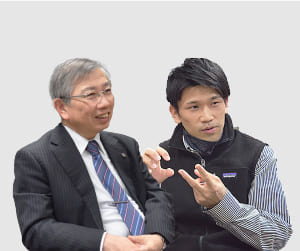
KATO Hirokazu (Executive Director/Vice President)
SAWABE Taishi (Associate Professor, Division of Information of Science) -
Work-Life Balance

Bermundo Juan Paolo Soria (Assistant Professor, Division of Materials Science)
-
Career Advancement
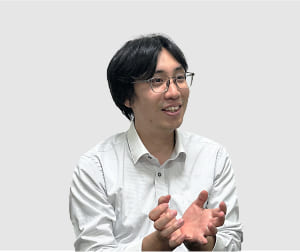
YAMASAKI Shotaro (Associate Professor, The University of Osaka)
Recruitment Promotion Site
