


This page provides data on NAIST’s education, research, and related activities.
NAIST is dedicated to fostering an excellent research environment that enables young faculty members to focus on their academic pursuits and develop their careers.
Student-to-Faculty Ratio (FY2023)
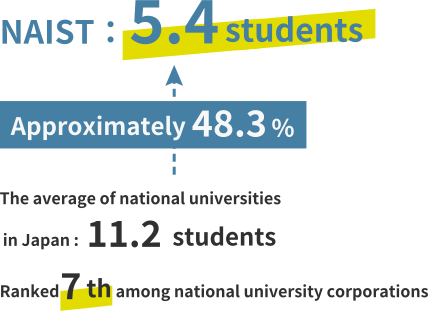
The student-to-faculty ratio at NAIST is less than half of the national average of 11.2 students per full-time faculty member. This environment enables faculty members to balance teaching responsibilities collaboratively while devoting ample time to advancing their research.
Source: National Institution for Academic Degrees and Quality Enhancement of Higher Education, “国立大学法人の財務(大学別概要)」令和6年度版(令和5年度決算)”
*Only Japanese
Research Expenditure per
Faculty Member (FY2023)
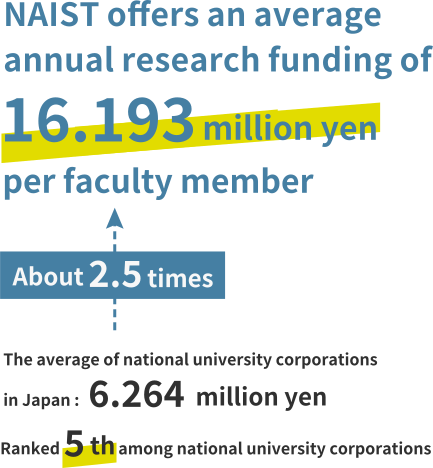
The research expenditure per faculty member refers to the amount of funding invested in research activities per faculty member, calculated by dividing the total research‑related expenses*1 (excluding personnel costs for faculty and staff, general administrative expenses, etc.) by the number of faculty members*2. A higher figure indicates greater research funding available per faculty member.
At NAIST, this figure is 16.193 million yen, which is approximately 2.5 times higher than the average for national university corporations in Japan (6.264 million yen). In FY2023, NAIST ranked 5th among the 82 national university corporations in Japan.
*1 Research Expenses + Commissioned Research Funding +Collaborative Research Funding + Grants-in-Aid for Scientific
*2 Research (Direct Costs)
Annual average number of full-time faculty members receiving salary payments (including fixed-term faculty)
Source: National Institution for Academic Degrees and Quality Enhancement of Higher Education, “国立大学法人の財務(大学別概要)」令和6年度版(令和5年度決算)”
*Only Japanese
Amount of External Research
Funding Secured
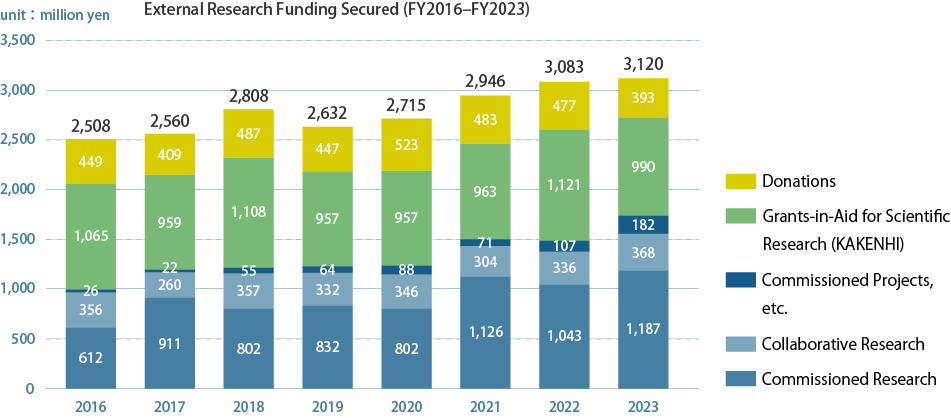
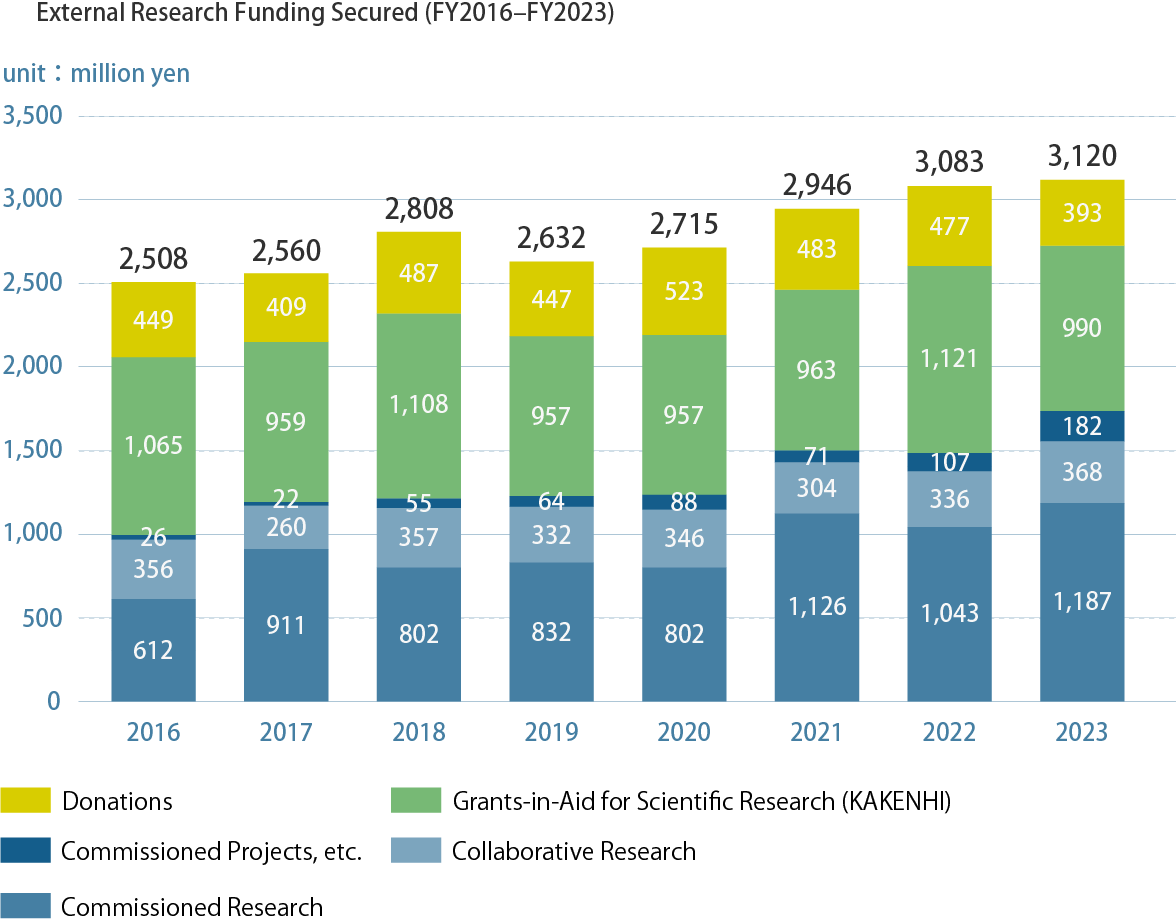
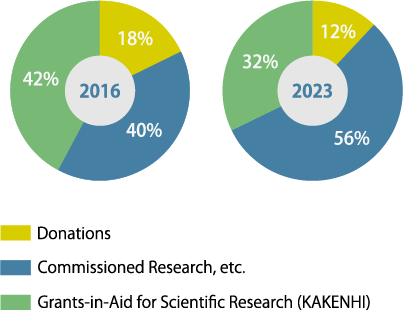
In the past, external funding at NAIST was largely dominated by Grants-in-Aid for Scientific Research (KAKENHI). In recent years, however, revenue from commissioned research and other related sources has increased, shifting the overall balance of research funding. To ensure an environment in which faculty and students can engage in education and research activities, NAIST is working to secure private funding and promote the President’s Vision 2030, which aims to achieve "Financial stability through diversified university revenue and bold investment in our education and research".
Proportion of Young
Faculty Members
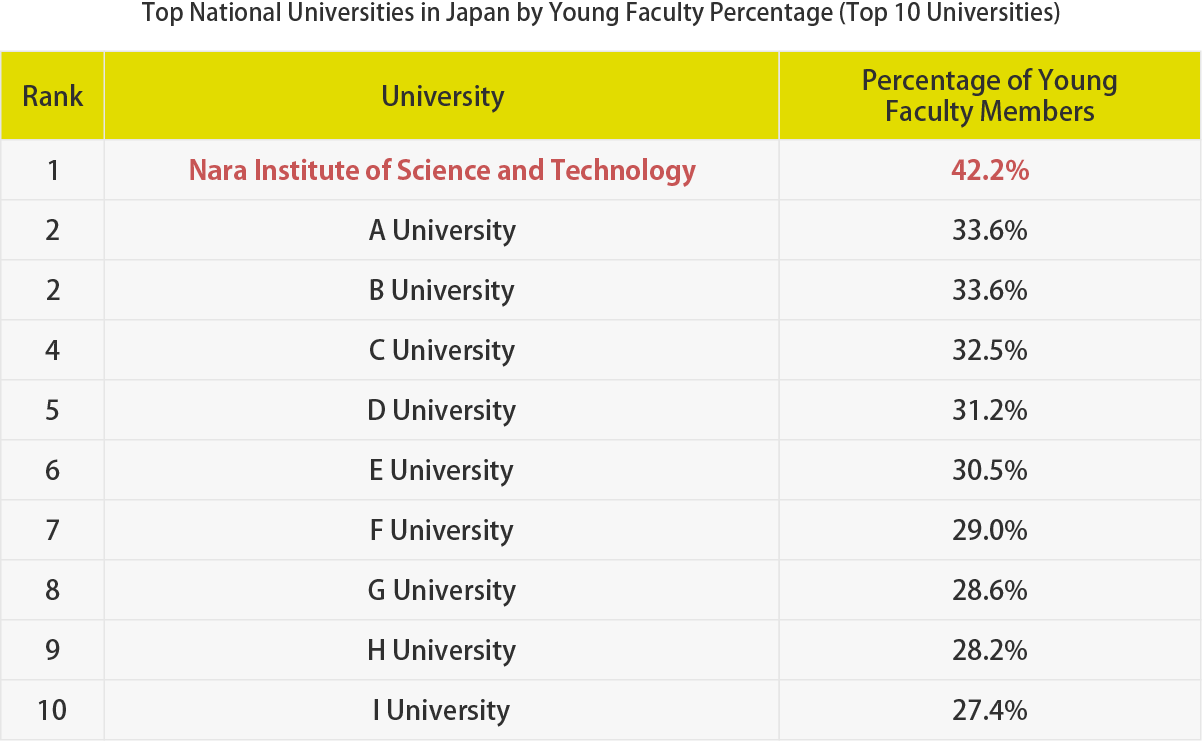
The proportion of young faculty members at NAIST significantly exceeds the “30% or more” target set in the 6th Science, Technology and Innovation Basic Plan (approved by the Government of Japan on March 26, 2021). This situation reflects NAIST’s position among the top national universities in Japan.
Source: Ministry of Education, Culture, Sports, Science and Technology (MEXT) FY2024 budget request “成果を中心とする実績状況に基づく配分」フィードバックデータ” . *Only Japanese
NAIST compiled FY2020–FY2022 data showing the proportion of full-time faculty members, including specially appointed faculty, who are under 40 years old.
Promoting the Growth and Advancement
of Young Faculty Members
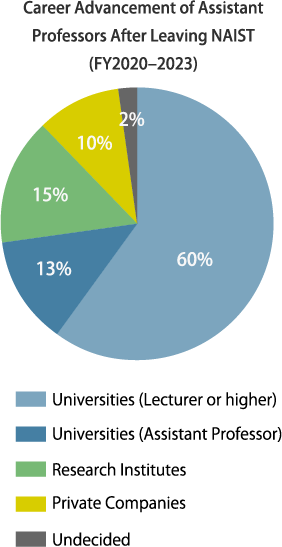
NAIST supports assistant professors by providing a research environment with well‑equipped facilities and strong institutional support, enabling them to enhance their academic achievements with the expectation that they will take the next step in their careers by the end of their term. As a result, more than 90% of our assistant professors advance their careers as researchers at universities, inter‑university research institutes, research organizations, and private companies.
On-Campus Staff Housing


NAIST provides on-campus staff housing, offering family units (Buildings B and C) as well as single-occupancy units (Building D).
Because the residences are located within the university grounds, faculty and staff can focus on their work without the burden of commuting. Many faculty members also find it convenient to return to their rooms briefly between experiments or research activities.
Parking facilities are available for those who wish to use them.
All residence buildings—B, C, and D—feature private rooms with ample living and storage space, ensuring a comfortable and supportive living environment.


