


Exploring Uncharted
Research Fields
OYAMA Ryoko(Assistant Professor, Functional
Organic Chemistry Laboratory,
Division of Materials Science)
Exploring Uncharted
Research Fields
OYAMA Ryoko(Assistant Professor, Functional
Organic Chemistry Laboratory,
Division of Materials Science)

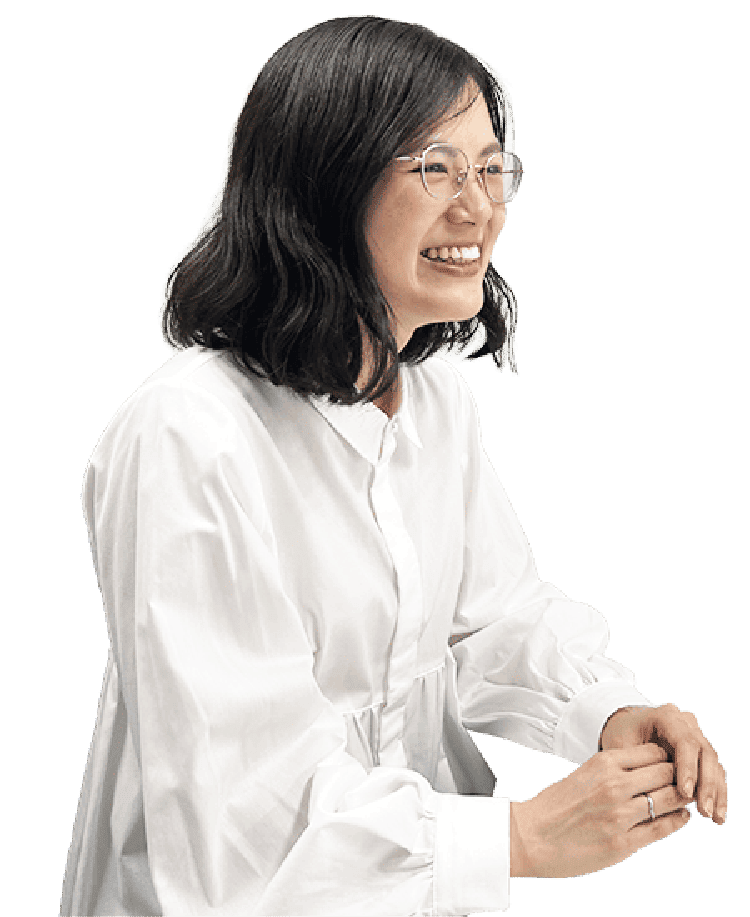
Assistant Professor Ryoko Oyama conducts research on organic materials that utilize light energy.
She aims to create new optically functional materials by clarifying the mechanisms of fluorescence and phosphorescence and improving their efficiency.
She also actively takes on challenge in research areas where studies have not yet progressed sufficiently and pursues her work from an unconventional perspective.
profile

OYAMA Ryoko (Assistant Professor)
Career
-
2018
Mar.
Bachelor of Science in Chemistry, School of Science, Hiroshima University
-
2020
Mar.
Master of Science in Chemistry, Department of Chemistry, Graduate School of Science, Hiroshima University
-
2023
Mar.
Doctor of Science, Chemistry Program, Division of Advanced Science and Engineering, Graduate School of Advanced Science and Engineering, Hiroshima University
-
Apr.
Postdoctoral Researcher, Okinawa Institute of Science and Technology Graduate University
-
2024
May.
Assistant Professor, Division of Materials Science, Graduate School of Science and Technology, NAIST
Hobbies
Tasting sake and beer, practicing English, and strength training
I enjoy tasting and comparing different kinds of sake and beer. When I travel for business, I often buy local sake or craft beer to enjoy later. I am also interested in interacting with researchers from abroad and hope to conduct research overseas. To improve my English, I regularly watch English videos on YouTube and listen to English conversation programs on the radio. In addition, I go to the gym on weekends for strength training to maintain physical fitness for my research life.
interview

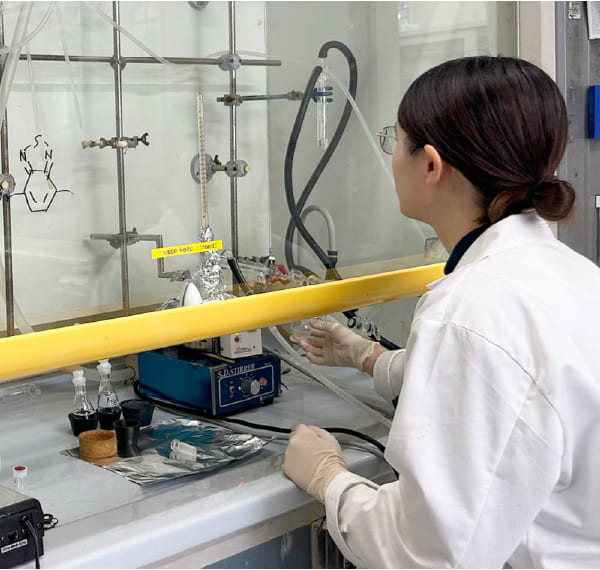
You joined NAIST as an assistant professor and launched a new research topic into the development of room-temperature phosphorescence materials that absorb light energy and emit phosphorescence with high efficiency. Phosphorescence, which is used in organic EL elements, emits light for longer periods of time than fluorescence that emits light using a similar mechanism. On top of that, its energy-saving properties are attracting attention because of the high energy utilization efficiency. With what ideas do you tackle research?
Fluorescence and phosphorescence are phenomena in which molecules absorb light, are promoted to excited states, and emit light as they return to the ground state. These excited states are classified into singlet and triplet states depending on the electron spin configuration. Phosphorescence occurs when an electron initially excited to a singlet state undergoes a spin flip to reach a triplet state and then returns to the ground state while emitting light. Since the transition from a triplet excited state to the ground state involves a spin flip, phosphorescence is characterized by a longer lifetime than fluorescence. In typical phosphorescence, when a molecule absorbs light, it is first excited to a singlet state and then transferred to a triplet state through multiple pathways. During this process, energy loss occurs, leading to reduced emission efficiency. Therefore, my focus is on a previously unexplored pathway in which molecules are directly excited from the singlet ground state to the triplet excited state. I believe that achieving such direct excitation will enable more efficient phosphorescence. Although this phenomenon is considered theoretically possible, there have been few experimental confirmations, which makes this research very challenging.
What outcomes have you achieved so far?
I’m conducting research aimed at developing organic materials that exhibit red and near-infrared phosphorescence, which are still relatively rare. In the course of this work, I unexpectedly found that a compound synthesized to investigate phosphorescence showed red fluorescence with high efficiency. By clarifying the mechanism behind this emission and applying it to molecular design, it may become possible to achieve high efficiency near-infrared fluorescence at wavelengths longer than red, which are widely used in medical and biological imaging. Inspired by this finding, I’m currently pursuing research on near-infrared fluorescent materials in parallel with my work on phosphorescence.
What sparked your interest in the phenomenon that lets molecules absorb light energy to excite them and increase their reactivity, which is underlying this research?
When I was an undergraduate student at Hiroshima University, I was particularly interested in a research topic I encountered during an on-campus introduction session. The topic was a photo-responsive drug delivery system for cancer treatment. In this system, when a drug reaches a cancer site, light irradiation breaks the bond between the drug and its carrier molecule, known as a photolabile protecting group, allowing the drug to become active. This mechanism interested me, and I began my research by studying how molecular bonds can be cleaved by light. My interest in this topic gradually deepened, and I decided to continue my studies through the doctoral program, during which I also had the opportunities to present my research at international conferences. Through this work, I learned that effective drug delivery systems often include luminescent molecules that serve as markers for cancer sites. This led me to become interested not only in light-induced reactions but also in luminescence phenomena themselves. After completing my doctoral studies, I joined the Okinawa Institute of Science and Technology Graduate University as a postdoctoral researcher, where I began to study the mechanisms of molecular luminescence more deeply. Through these experiences, I learned how important it is to develop my research while keeping a consistent theme.
It’s been a little over a year since you were appointed to NAIST. What do you find good in the research and education environment?
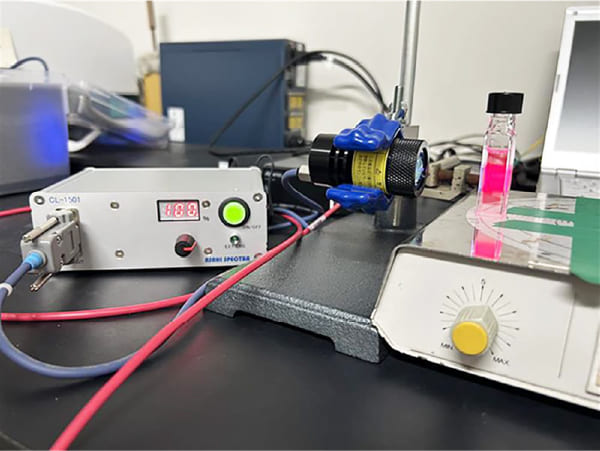
The startup research funds for newly hired female faculty members have been a great support for me. When I first joined the university, I had little research funding available, but this grant was provided soon after I applied, which was a great help. With this support, I was able to begin my research promptly by purchasing essential equipment, such as LED lamps for photoexcitation and detectors for measuring emission spectra.
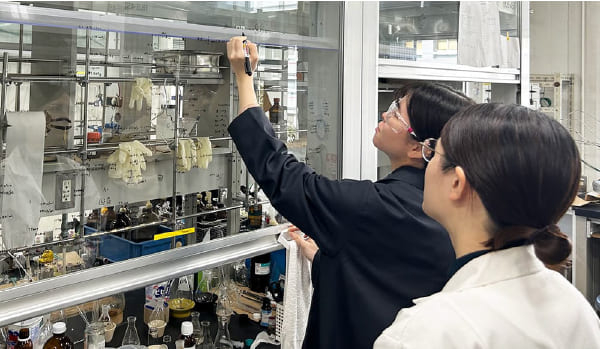
In addition, the university is well equipped with excellent experimental facilities, and I find the professional and dedicated support provided by the technical staff members to be one of its greatest strengths. When I explain the characteristics of my samples and my research objectives, they promptly suggest appropriate measurement methods and help obtain high-quality data efficiently. Their support in my day-to-day research activities is truly reassuring.
Furthermore, in the Functional Organic Chemistry Laboratory, where I am currently based, students are actively encouraged to engage in activities outside of the university, such as presenting their work at academic conferences. By participating in joint research meetings with laboratories at other universities and in gathering of young researchers, students have opportunities to interact with researchers beyond their own institutions. I feel that these experiences broaden their perspectives and increase their motivation for research.
What kind of researcher do you want to be in the future?
I aim to continually elucidate unknown phenomena through my research. I also believe that, in order to sustain long-term research activities, it is important to produce results that respond to societal needs while taking social and economic trends into account. In addition, I am particularly interested in unexplored fields where research has not been sufficiently advanced, and I would like to pursue such topics patiently over the long term. In particular, I focus on aspects of the theories proposed by earlier scientists that have not yet been experimentally verified. I value re-examining these theories and building on them as my own original research.
In January 2025, I married a researcher in the same field of photochemistry. As we both value our respective research environments, we currently live in separate locations, Nara and Fukuoka. We continually share discussions about our research and inspire each other. In the future, I hope to conduct my research in closer proximity.
See other interviews
-
Work-Life Balance
and Career Advancement
OHTSU Mina (Assistant Professor, Hokkaido University)
-
Startup Creation
KATO Hirokazu (Executive Director/Vice President)
SAWABE Taishi (Associate Professor, Division of Information of Science) -
Work-Life Balance

Bermundo Juan Paolo Soria (Assistant Professor, Division of Materials Science)
-
Academic Experience
at Other Universities
KASHIWA Yutaro (Associate Professor, Division of Information of Science)
-
Career Advancement
YAMASAKI Shotaro (Associate Professor, The University of Osaka)
Recruitment Promotion Site
