


Taking on the Challenge
of an Interdisciplinary Field
that Paved the Way for Me
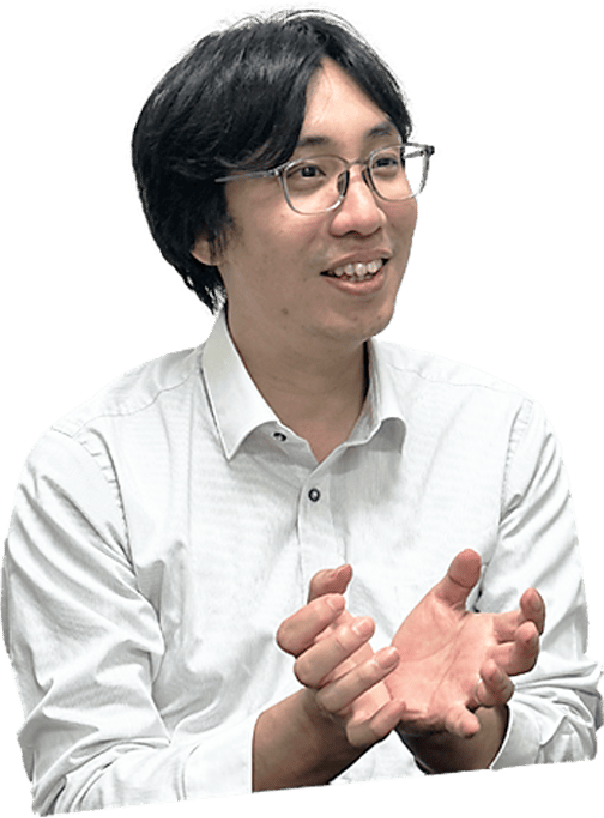
YAMASAKI Shotaro (Associate Professor,
Research Institute for Microbial Diseases,
The University of Osaka,
Adjunct Associate Professor, NAIST)
Taking on the Challenge
of an Interdisciplinary Field
that Paved the Way for Me
YAMASAKI Shotaro (Associate Professor,
Research Institute for Microbial Diseases,
The University of Osaka,
Adjunct Associate Professor, NAIST)

Prof. Shotaro Yamasaki, after completing the doctoral course at Nara Institute of Science and Technology (NAIST), served as a postdoctoral researcher and then as an assistant professor in the Division of Biological Science.
He is currently an adjunct associate professor at NAIST. Additionally, he was appointed an associate professor at the Bioinformatics Center, Research Institute for Microbial Diseases, The University of Osaka, in April 2024.
profile
YAMASAKI Shotaro (Associate Professor)
Career
-
2016
Mar.
Doctor of Bioscience, Graduate School of Bioscience, NAIST
-
Apr.
Postdoctoral Fellow, Graduate School of Bioscience, NAIST
-
2021
Apr.
Assistant Professor, Division of Bioscience, Graduate School of Science and Technology, NAIST
Assistant Professor, Center for Digital Green-innovation, NAIST (Concurrent position) -
2024
Apr.
Associate Professor, Laboratory of RNA Informatics,
Department of Biological Informatics, Bioinformatics Center, Research Institute for Microbial Diseases, Osaka University (The official English name was changed to “The University of Osaka” in April 2025)
Adjunct Associate Professor, Division of Bioscience, Graduate School of Science and Technology, NAIST
Hobbies
Playing video games.
I have always loved building games, survival games, and city-building games since my days as a student. Now, I spend less time playing video games; instead, I spend more time crafting, playing with LEGO blocks, and exercising outside with my children. However, I look forward to playing games like Minecraft with my children when they get a little older.
Crafting
While making origami and crafts out of milk cartons with my children, I found that I was crazy about such craft projects. So, I might even call crafting one of my hobbies now.
interview

What is your continued research theme?
By focusing on the molecules called messenger RNA (mRNA), I am studying the process by which genetic information in DNA within the cell nucleus functions as a protein, in other words, the control mechanism for gene expression. DNA can be referred to as the blueprint for life by encoding the genetic information (sequence of nucleic acid bases) for the various proteins involved in forming organisms and the molecular reactions within cells. When producing a specific protein, only the region of DNA containing that genetic information is transcribed (copied) into mRNA. During this process, strict regulation ensures that proteins are produced in the appropriate amount at precisely the right time. Within this regulation, the amount of mRNA transcribed and the genetic instructions encoded in the transcribed mRNA play important roles.
In basic research, in order to understand the regulatory mechanisms of gene expression, which is the foundation of life activities, I aim to clarify the mechanism that determines the amount of mRNA and the role of the genetic instructions encoded in mRNA. In applied research, I am engaged in the development of mass production technology for medical proteins by using the knowledge gained from my research. Even with current information processing technology, it is not easy to completely decipher and freely use the DNA, the blueprint for life. I’m tackling this difficult challenge by particularly focusing on a simpler genetic blueprint than DNA, encoded in mRNA.

What research results have you achieved so far?
Protein production efficiency is regulated by multiple factors, and the regulatory elements are distributed across various regions of mRNA. This makes systematic analysis challenging. Therefore, I employ the large-scale data acquired through my own method and machine learning to model the relationship between the base sequences of mRNA and protein production efficiency. This modeling results in an advanced understanding of significant regulatory elements. Furthermore, by applying my model, I developed a base sequence optimization technology to improve production efficiency. This technology uses models to predict production efficiency from mRNA, which enable the design, evaluation, and improvement of sequences to be run on a computer. This can significantly reduce the number of experiments as well as the time and cost required for research. We are currently making improvements that consider multiple regulatory processes for the various species and different regions of mRNA. Some of these have already led to practical applications.
Some proteins are highly valuable in the medical and food industries, but some are quite expensive. One example is the growth factors essential for producing cultured meat. I developed a system for designing highly efficient mRNA targeting a cell-free protein synthesis system using wheat germ extract, which has successfully reduced the cost of synthesizing growth factors. This research was conducted in collaboration with a company in Awaji City, Hyogo Prefecture. NAIST is located within Kansai Culture and Science City, where research facilities are clustered. Therefore, our university receives many collaborative research requests from companies that seek to use our research seeds.

The research method for predicting protein production like this is a field that combines bioscience and information science and is called bioinformatics, which analyzes biological phenomena by using computers. Did the research environment at NAIST, which actively promotes the integration of different fields, have any influence on you?
It had a big impact because it determined the direction of my research. Since I was originally interested in biology, I enrolled in NAIST after attending a technical college with a biology department and then the Faculty of Agriculture, Kobe University. I had conducted wet research (research based on experiments) until my master’s degree. However, my encounter with bioinformatics, a type of dry research (research based on computer analysis), during my doctorate degree marked a major turning point. At that time, I was conducting research on plant mRNA translational control under Professor Ko Kato at the Laboratory of Plant Metabolic Regulation (currently a professor at the Laboratory of Bioengineering). During that research, I learned that Prof. Kato had previously collaborated with Professor Shigehiko Kanaya at the Laboratory of Computational Systems Biology in the Division of Information Science to work on data analysis of gene expression regulation. This was the trigger that led me to take an interest in a field in which I had no prior experience.
Prof. Kanaya taught me the basic techniques of information science. I became convinced that data analysis methods and concepts could be applied to my own research, which then led me to become fully absorbed in dry research. I acquired the theory in the field of information science and its various research methods almost entirely on my own while I studied for my doctoral degree and as a postdoctoral researcher. Now, my main research field is bioinformatics. I built the background of new research while remaining devoted to interdisciplinary research at university, which is still helping me today.
Even from a faculty member’s perspective, having students like me, who are accepting the challenge of interdisciplinary research, would bring positive stimulation to the research environment. If I’m not being conceited, I believe that during my studies at my university, I had a mutually stimulating relationship with my supervisor, Prof. Kato, and influenced his research approach.
From my experience, I realize that our university’s projects promoting next-generation interdisciplinary research will create a great opportunity for both students and faculty members. Currently, our university offers the NAIST Granite Program and the Digital Green Innovation Program. Students have more opportunities to study interdisciplinary fields than we did when I studied at university. I also encourage the students I supervise to actively participate. Furthermore, NAIST provides such programs as the Next-Generation Interdisciplinary Research Promotion Project, which supports interdisciplinary collaboration among faculty members. These kinds of support allow the matching of researchers with mutual interests, which enable them to acquire high-quality data and conduct thorough validations and which leads to mutually beneficial research. If researchers aim to advance research through interdisciplinary approaches, I will say that NAIST is in an extremely favorable environment.

You’ve spent over ten years at NAIST as a student and a faculty member. What are your impressions of its environment for research and education?
The balance between research and education at NAIST is excellent. It is a graduate school without undergraduate programs. Therefore, the number of students is smaller than at typical universities where undergraduates are enrolled, and I have the impression that many of the students are highly motivated to conduct research. NAIST focuses on students in the master’s or higher degree programs, so the level of research is also high, allowing for the formation of small but elite laboratories. The low student-to-faculty ratio is among the lowest in the nation. Therefore, students receive fulfilling guidance. The environment balances the burden of guiding students with the positive impact on research for faculty members, too. In addition, the Division of Bioscience offers a system where not only the supervisor in your own lab but also faculty members from other labs act as advisors to support master’s theses and doctoral dissertations. Through these advisory interviews, I received valuable feedback that was useful for my research from professors and other senior faculty members that I rarely had the opportunity to speak with.
Furthermore, because it is a graduate school, NAIST offers fewer classes than universities with undergraduate courses. On the other hand, in order to advance your career as a faculty member, not only research but also teaching achievements are emphasized. The Division of Bioscience even offers lectures where you can teach on a one-hour basis, such as a lecture in which you can introduce your own research as a cutting-edge research topic if you volunteer. This allows even a new faculty member with no teaching experience to gain lecture experience with little burden. I think it is a great environment to build a track record while balancing research and teaching.
Moreover, NAIST provides university housing near the campus at low rent for students and faculty. As such, the university offers a fulfilling research environment where I can devote myself to research without time restrictions, which also has supported my research life.
 Please share a message
with young researchers.
Research is not something that can be conducted alone. Of course, supervising students is sometimes difficult. However, the students who enroll in NAIST are in the master’s and doctoral courses. I’m sure that students and faculty can build wonderful relationships where they inspire each other and grow rather than faculty just teaching. For young researchers who cannot afford to hire research assistants or technical staff, the encounter with outstanding students will be a great asset. NAIST offers a well-balanced research and teaching system with excellent facilities. I think that you’ll surely be able to advance both your research and teaching in this environment. I love NAIST, where I spent my time from my days at university to the days as an assistant professor. I hope that talented young researchers will enroll in NAIST and help make this university even more exciting.
See other interviews
-
Uncharted Research Fields
and Future Outlook
OYAMA Ryoko (Assistant Professor, Division of Materials Science)
-
Work-Life Balance
and Career Advancement
OHTSU Mina (Assistant Professor, Hokkaido University)
-
Startup Creation
KATO Hirokazu (Executive Director/Vice President)
SAWABE Taishi (Associate Professor, Division of Information of Science) -
Work-Life Balance
Bermundo Juan Paolo Soria (Assistant Professor, Division of Materials Science)
-
Academic Experience
at Other Universities
KASHIWA Yutaro (Associate Professor, Division of Information of Science)
Recruitment Promotion Site
